
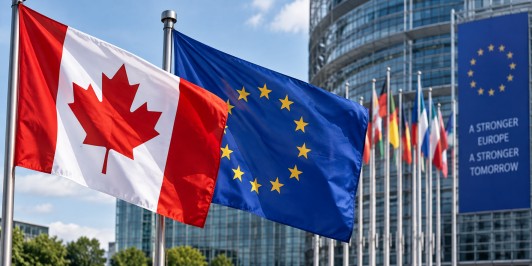
As Canada faces increasing trade tensions with the United States, the nation is actively pursuing stronger economic and strategic relationships with the European Union. Prime Minister Mark Carney has engaged in discussions with leaders from key EU countries like France, Germany, and Italy to explore avenues for closer ties that stop short of full EU membership. Canadian officials are particularly interested in an associate membership that could grant them greater access to the EU’s single market.
The focus of this potential collaboration spans several strategic sectors. Canada is eyeing cooperative efforts in energy, artificial intelligence, critical minerals, defense, technology, and infrastructure. Additionally, there is interest in enhancing connections in research, higher education, data centers, telecommunications, and satellite networks. Such diversification efforts are aimed at reducing Canada’s economic dependency on the United States, which currently absorbs approximately two-thirds of its exports.
Part of Canada’s strategy involves bolstering energy linkages with Europe. The plan includes the development of infrastructure to facilitate the export of Canadian natural gas to European markets, a move that could help Europe lessen its reliance on Russian energy supplies. This initiative aligns with Canada’s broader objective of diversifying its economic partnerships and reducing its vulnerability to U.S. trade policies.
While the Canadian government is keen on strengthening ties with the EU, European nations have been cautious in their response to the proposals. Although closer cooperation could unlock new economic opportunities, it also risks further straining the already delicate relations between the EU and Washington. The prospect of Canada getting closer to the EU could add to the geopolitical and economic complexities that European countries must navigate.