
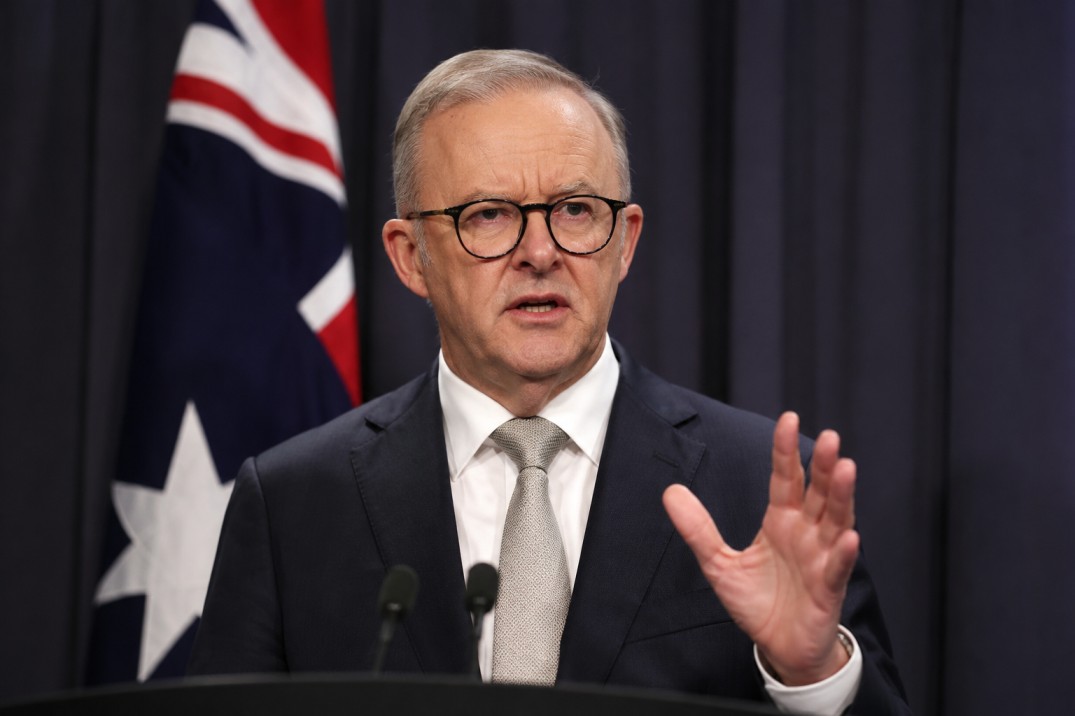
During a recent visit to the Solomon Islands, Australian Prime Minister Anthony Albanese issued a strong rebuke of China’s latest military maneuver, which involved testing a nuclear-capable intercontinental ballistic missile over the Pacific Ocean. Albanese expressed deep concern over the missile launched from a nuclear-powered submarine, emphasizing that its potential for destruction, if armed with a nuclear payload, poses a significant threat to regional peace and stability. He reiterated Australia’s stance against the proliferation of nuclear weapons in the region and affirmed that his government would persist in voicing these concerns directly to Beijing.
The missile test has been described by Albanese as a provocation that risks fueling instability throughout the Pacific. Echoing these sentiments, Solomon Islands Prime Minister Matthew Wale also condemned the launch, urging major global powers, including both China and the United States, to refrain from conducting missile tests in the Pacific. Wale advocated for stronger partnerships with Pacific nations over actions that could lead to security threats.
In response to the criticism, China characterized the missile launch as a standard military exercise, asserting that it was carried out in compliance with international law. Beijing claimed that neighboring countries were notified in advance of the test and assured that the exercise was not directed at any particular nation. However, Australian officials dismissed these explanations, arguing that the advance notice was inadequate and that the test did not adhere to widely accepted international protocols for ballistic missile notifications.
The missile test has sparked a wave of criticism from various countries, heightening concerns about the escalation of military activities in the Indo-Pacific region. Such actions are feared to potentially exacerbate regional tensions and ignite a new era of strategic rivalry. As nations in the region grapple with these developments, the call for de-escalation and diplomatic engagement becomes increasingly urgent.