
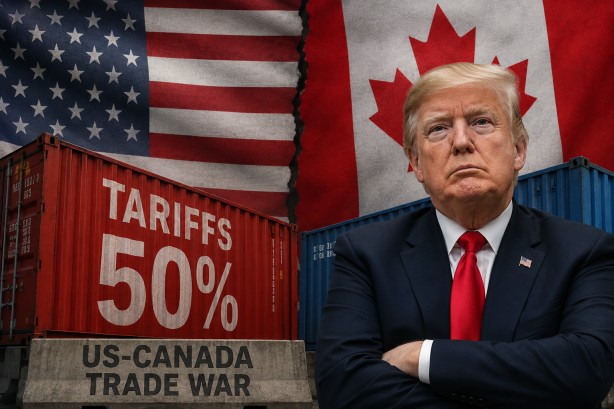
In a significant escalation of trade tensions, President Donald Trump has intensified the dispute with Canada following a breakdown in negotiations held in Washington. The United States has implemented 50% tariffs on approximately $20 billion worth of Canadian products, targeting items such as hockey sticks and medical supplies. In response, Canadian Prime Minister Mark Carney has pledged to retaliate with equivalent tariffs, asserting that Canada will adopt measures against U.S. goods on a “dollar for dollar” basis starting September 8.
Prime Minister Carney has characterized the U.S. tariffs as an assault on Canada and has firmly rejected the demands presented during the negotiations. Meanwhile, U.S. Trade Representative Jamieson Greer has justified the tariffs, stating they are essential to safeguard American workers and supply chains. This trade friction is causing concern over the potential impact on the United States-Mexico-Canada Agreement (USMCA), the trade pact that governs around $2 trillion in annual trade among the three countries.
The rising tensions between the United States and Canada could have significant repercussions, including increased costs for both businesses and consumers. The economic relationship between the neighboring nations could face further strain as a result of these measures. The USMCA, a critical framework for North American trade, now faces uncertainty as the dispute threatens the stability and cooperation it was designed to promote.
The imposition of these tariffs marks a notable development in the ongoing trade disagreements, highlighting the complexities of international economic relations. Both nations are preparing for the potential fallout as they brace for the economic implications of this trade conflict. As the situation evolves, businesses and policymakers on both sides of the border are closely monitoring developments, aware of the potential for broader economic consequences.